 Pancakeswap
 Routes Swaps and Supports Liquidity Positions From Setup to Exit
Pancakeswap turns a wallet-selected trade into an on-chain state change through quoted routing and wallet authorization. It supports token swaps, liquidity positions, cross-chain routes, and selected leveraged markets without requiring a custodial exchange account. A usable starting record includes the correct network, token identifier, spend balance, wallet address, and any native gas asset the route requires. The interface estimates output, route, fees, and price impact before the wallet signs. Completion occurs only after the required on-chain transactions are confirmed and the resulting balance or position can be verified. Reaching the intended end state may mean swapping back, removing liquidity, collecting available fees, closing a position, or receiving assets on another chain. Each path has distinct costs, timing dependencies, and reversal limits.
Trading, Liquidity, and Market Paths
Spot Swaps
Spot swaps exchange one token for another against liquidity pools or eligible market-maker quotes. Depending on the network and pair, the Smart Router can draw from V3, V2, or StableSwap pools and compare eligible market-maker quotes against AMM routes. Multihop routing may pass through an intermediate token, while split routing can divide the order across paths. The displayed output remains an estimate until execution because liquidity and chain conditions may change before signature.
Liquidity Positions
Liquidity provision commits assets to a pool so other users can trade against them. The position earns a share of eligible trading fees, but its token composition can change as the market moves. Concentrated-liquidity pools also require a selected price range. A narrow range concentrates capital across fewer prices, but it stops earning trading fees while the market remains outside that range. Farm incentives, when available, are separate from ordinary pool fees.
Entry and Specialized Markets
Fiat on-ramps, bridges, and perpetual markets serve different purposes. An on-ramp uses an integrated payment provider to acquire tokens, subject to that provider’s regions, methods, checks, and charges. A bridge changes the network holding an asset. Perpetual trading opens a collateralized position whose value and liquidation exposure follow the selected market rather than transferring ownership of a spot token.
Wallet, Network, and Starting Record
The starting record should capture the wallet address, selected chain, token identifier, spend balance, any required gas balance, and intended receiving asset. A ticker cannot establish token identity because unrelated assets on the same or different networks may share the same symbol. Network selection also determines which balance, liquidity, and gas market apply. Quotes are time-sensitive rather than promises: a later route may use different pools or produce another minimum output. Keeping the initial quote and transaction hash makes the confirmed change easier to reconcile.
How Does a Swap Move From Quote to Settlement?
A swap moves from an indicative quote to settlement through routing, authorization, and chain confirmation.
Quote and Route
The quote begins with an input token, output token, and amount on the selected network. Routing evaluates available paths and presents an estimated output, trading fee, price impact, and minimum received under the chosen slippage tolerance. Route details matter because an indirect or split path may produce a better estimate than a direct pool. Refreshing the quote before signing reduces the chance of reviewing stale terms.
Allowance and Signature
On networks that use token allowances, an allowance lets a contract spend up to an authorized amount; it is not the swap itself. A first interaction on those networks may therefore require an approval transaction before the trade can be submitted. The wallet then shows the swap request separately. Its network, invoked contract or program, spending amount, and any estimated network fee should match the reviewed quote. Rejecting either request leaves that stage incomplete.
Confirmation and Reconciliation
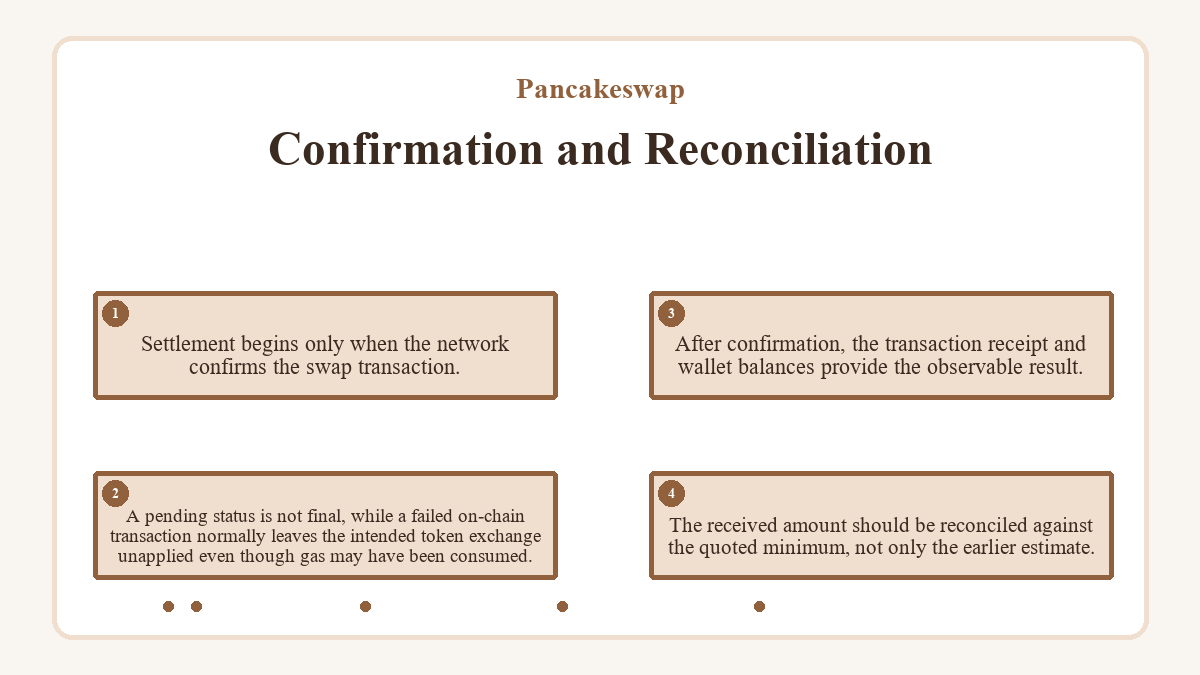
Settlement begins only when the network confirms the swap transaction. A pending status is not final, while a failed on-chain transaction normally leaves the intended token exchange unapplied even though gas may have been consumed. After confirmation, the transaction receipt and wallet balances provide the observable result. The received amount should be reconciled against the quoted minimum, not only the earlier estimate.
Costs, Price Impact, and Minimum Output
Execution cost combines different effects rather than one universal percentage. The selected pool or market-maker route determines any trading charge, while network conditions determine the transaction fee. Price impact is the order-driven difference between the current market price and the quoted execution price, and it depends on available liquidity. Slippage tolerance is an execution boundary, not another fee: the transaction should fail if the obtainable output falls below its encoded minimum. Cross-chain routes may add bridge or relayer charges, while perpetual markets introduce position fees and funding. The confirmation view should expose the applicable live terms before commitment.
Liquidity Position States and Exit
Pool and Range Selection
Pool selection establishes the token pair, exchange version, fee arrangement, and pricing model governing a position. In concentrated liquidity, the chosen range decides where the assets actively support swaps. Deposited token proportions can differ with the current price and range, so equal values are not a universal entry condition. The position record should retain its pool, range, and ownership identifier.
Active and Inactive Liquidity
Active liquidity earns eligible fees when trades pass through the prices covered by the position. A V3 concentrated-liquidity position earns trading fees only while the market price remains inside its chosen range. Outside the range, its assets can become concentrated in one token and fee generation pauses until price returns. This exposure can create impermanent loss relative to holding the original assets, and accumulated fees may or may not offset the difference.
Removal and Reconciliation
Position removal is a new on-chain action, not an automatic reversal of the deposit. The owner can choose a partial or full withdrawal and review the estimated token amounts before signing. Fee handling varies by position type: some fees require a separate collection action, while other designs include them in the withdrawn amounts. After confirmation, compare received balances, any remaining position value, and unclaimed rewards before treating the exit as complete.
Cross-Chain and Leveraged Settlement States
Cross-chain execution adds a transport stage between the source balance and the intended destination result. Supported chains, tokens, and providers depend on the route available when the quote is requested.
A cross-chain swap can combine a source-chain swap, a bridge transfer, and a destination-chain swap in one routed transaction. Each component still has its own liquidity and execution conditions, even when the interface presents one combined action.
Bridge progress should be checked beyond the source transaction. If the source-chain swap fails, the original token remains on the source chain. If the bridge transfer fails, the provider’s recovery process can return the bridged asset on the source chain. If the destination swap fails, the bridged asset can arrive on the destination chain instead of the requested final token. The route determines the recovery state and timing.
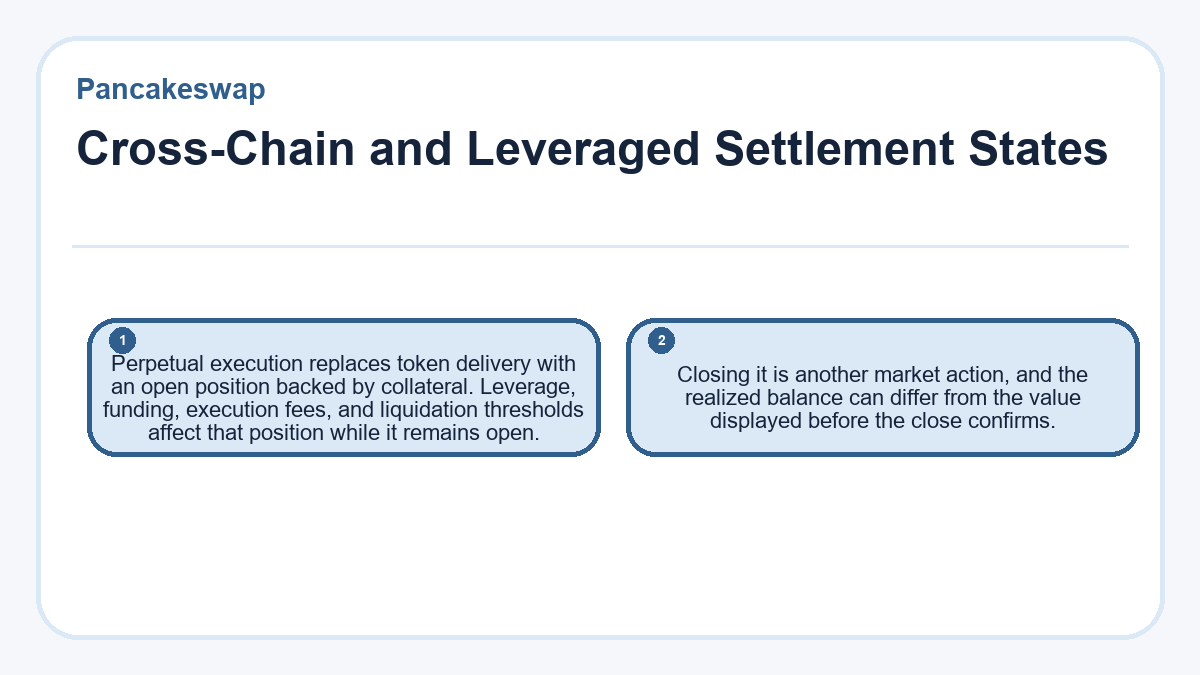
Perpetual execution replaces token delivery with an open position backed by collateral. Leverage, funding, execution fees, and liquidation thresholds affect that position while it remains open. Closing it is another market action, and the realized balance can differ from the value displayed before the close confirms.
Spot, cross-chain, and leveraged paths therefore finish at different observable states. A spot swap ends with a confirmed wallet balance, a cross-chain route ends on the destination network, and a perpetual trade ends only after the position is closed and collateral is reconciled.
What Should Be Checked Before the Final Signature?
The final signature should follow a check of token identity, route economics, authorization scope, and the planned exit state. The wallet request is the last point where an unconfirmed action can be rejected without creating the proposed on-chain change.
- Match the wallet network and receiving address to the quoted route.
- Confirm both token identifiers, the spending amount, and the estimated minimum output.
- Review route details, trading charges, price impact, and any required gas balance.
- Read the approval scope and the contract or program interaction shown by the wallet.
- Identify whether exit requires a swap, liquidity removal, bridge completion, or position close.
A confirmed receipt should then be matched with the expected balance or position state. That comparison separates a submitted instruction from a completed trade and preserves the record needed for any later exit.
Still wondering about Pancakeswap?
Does Connecting a Wallet Give Pancakeswap Control of Your Tokens?
No. Connecting a wallet normally exposes its public address and lets the interface read balances; it does not itself transfer tokens. A transfer requires a later wallet signature or an existing permission a contract can use. Read each signature request as a separate action, check its contract and network, and reject any request whose effect does not match the intended swap or position change.
Can Every Token Be Swapped If It Appears in a Wallet?
No. A token needs a supported network, a valid chain-specific identifier, and an executable liquidity route. A matching ticker alone is not enough because unrelated assets can use the same symbol. If the router cannot produce a route or the expected output is unusably low, the trade has no sound execution path at that moment. Changing the amount may alter routing, but it does not authenticate the token.
What Happens If a Swap Transaction Remains Pending?
A pending transaction has not settled, so the intended balance change should not be treated as complete. Check its transaction hash in a suitable block explorer. On an EVM network, also check its nonce, the account’s transaction sequence number, then use only the replacement or cancellation controls the wallet and network support. Submitting conflicting actions blindly can create more uncertainty. On an EVM network, later transactions from the same wallet may also wait behind the pending nonce.
Do I Need a network’s Native Token When Swapping Another Asset?
Most ordinary on-chain actions require the network’s native asset for gas, even when neither side of the swap uses that asset. Approval, swapping, adding or removing liquidity, claiming fees, and closing a position may create separate transactions. A gasless route is an exception only when the quote explicitly offers it. Cross-chain activity may also leave the wallet needing gas on the destination network.
Which Token Address Should I Use When Several Assets Share a Ticker?
Use the contract or mint address for the intended asset on the selected network, not the ticker by itself. The same symbol can identify unrelated or fraudulent tokens, and an address valid on one chain does not establish the asset on another. Confirm the address before approving spending because a successful transaction can still exchange the wrong token if the initial selection was wrong.
Can Pancakeswap Reverse a Confirmed on-chain Swap?
No. A confirmed on-chain swap cannot be canceled by the interface. Reversing the exposure requires a new swap using the route and liquidity available at that later time, with its own gas, fees, and price impact. Bridges and perpetual positions likewise have separate exit actions. Closing or swapping back should therefore be treated as another transaction, not an undo command.
Does a Token Approval Expire After One Swap?
Not necessarily. An approval can remain until its allowance is spent, it expires under the authorization design, or the owner revokes it. Confirming a swap does not always remove a broader permission. Wallet or explorer approval tools can display active allowances. Revocation is another on-chain transaction and requires gas, while revoking before a dependent pending swap settles may cause that swap to fail.
Are Network Fees Charged When a Trade Fails?
Yes. When a network records a failed transaction, it can still charge a transaction fee for the work performed. A rejected wallet request or an unsent transaction has not reached the chain and therefore incurs no on-chain transaction fee. This network cost is separate from a pool trading fee, which applies when swap execution occurs. The transaction receipt distinguishes failure from a request never submitted.