 Pancakeswap
 Lets You Set Execution Bounds and Verify a Swap’s Outcome
Pancakeswap gives each swap a live quote, route, fee display, price-impact estimate, and slippage setting before authorization. The slippage value sets an execution boundary; it does not lock the quote. After submission, the wallet status, transaction receipt, and final token balance show what actually settled. Custom routing, token behavior, and whether the wallet submits a transaction or signs an order can change which record completes the check.
The short version: A live quote becomes meaningful only when its route, execution bound, authorization, and settled token balance agree.
Quote Inputs Become Execution Conditions
A swap quote is an executable proposal built from the selected network, token contracts, amount, available liquidity, and permitted routes. Changing any of those inputs creates a new proposal. The displayed output remains an estimate until the swap settles, so the useful starting record is the complete quote rather than a token pair and headline rate alone.
Asset Identity and Network
Asset selection determines which token contracts the router can use on the connected network. A ticker or token name does not uniquely identify a contract. Before comparing outputs, match the selected network, input contract, output contract, wallet address, and spend balance. A mismatch can produce no route, an irrelevant balance, or a transaction on the wrong chain.
Trade Size and Price Impact
Trade size changes the quote because an automated market maker draws from finite pool liquidity. Price impact describes how the proposed trade itself changes the execution price relative to the pool’s starting state. Slippage describes movement between quotation and execution. A smaller amount or different route may reduce price impact, while a wider slippage limit merely accepts a broader execution range.
Slippage as an Acceptance Rule
Slippage tolerance defines how far execution may move from the quoted terms before the swap is rejected. For an exact-input trade, the transaction expresses that protection as a minimum acceptable output. For an exact-output trade, it limits the maximum input. A narrow setting may cause a revert when pool state moves; a wide setting permits a less favorable fill. If the interface offers an automatic setting, treat its displayed value as a live calculation, not a permanent protocol constant.
Routing Controls Change the Candidate Paths
Routing settings determine which liquidity paths may compete for the trade. The router can consider eligible pool versions, direct paths, multihop paths, split routes, and separate market-maker quotes where supported. Excluding a source does not improve that source. It removes the source from consideration and can leave a worse quote or no executable route.
Direct, Multihop, and Split Paths
A direct path swaps the selected tokens without an intermediate asset. A multihop route uses one or more intermediate assets, while split routing divides the amount across separate paths. These controls solve different problems. Turning either feature off narrows the search, so the route, fee, price impact, and expected output should be compared again after every change.
Wallet Transactions and Signed Orders
A wallet-submitted swap creates an on-chain transaction. When an eligible route is labeled Pancakeswap X, the interface may instead request a signed order for liquidity providers to fill. Availability depends on the selected assets, amount, and network. The order path has its own status record, while any token approval remains a separate on-chain action.
Six Stages Connect the Quote to the Record
The swap process has six observable stages. Each stage creates information the next one relies on, and each branch has a condition capable of stopping or changing execution.
| Stage | Record to Read | Condition That Changes the Branch |
|---|---|---|
| Set the context | Wallet address, network, and both token contracts | An unsupported network or token combination produces no route |
| Build the quote | Input, estimated output, fee, price impact, and route | Balance and available liquidity constrain the usable amount |
| Choose controls | Slippage mode, tolerance, and routing selections | Custom exclusions may remove every executable path |
| Authorize when required | Spender contract and allowance shown by the wallet | The allowance must cover the intended token input |
| Submit the swap | Transaction hash or signed-order status | An expired quote or violated execution bound stops the intended fill |
| Reconcile settlement | Receipt status, actual balance change, and interface history | The settled record replaces the earlier estimate |
Keeping the pre-sign quote makes reconciliation concrete. Record the token contracts, amount, route, fee display, execution bound, and destination wallet. After settlement, compare those fields with the transaction or order record and the actual balance change. A refreshed quote supersedes the old proposal, so its terms should not be mixed with an earlier submission.
Approval and Submission Create Separate Commitments
Authorization may involve more than one wallet request. A token approval grants a specified spender permission to use an allowance, while the swap transaction or order signature authorizes the exchange action. Treating both prompts as one operation makes it harder to identify what succeeded.
Token Allowance
An approval should show the token, spender, network, and allowance amount. It does not prove a swap occurred or reserve a quoted output. If the approval is insufficient, the later submission cannot spend the intended amount. If it is broader than the immediate trade, its scope also extends beyond the input needed for that one swap until the allowance changes.
Wallet-Submitted Transaction
A wallet confirmation is the final opportunity to reject the transaction before broadcast. The wallet should agree with the interface on the network, calling contract, input asset, and spending amount. Once broadcast, the transaction can remain pending, confirm successfully, or revert. Only a successful receipt establishes a settled swap; an interface success animation by itself is not the authoritative record.
Signed-Order Submission
A Pancakeswap X signature submits an order rather than a wallet-funded AMM swap transaction. The order can remain open while eligible liquidity providers respond. A successful fill sends the output to the wallet and updates the order status. If token approval was required first, that approval has its own transaction record and may consume a network fee even though signing the order does not.
Failure States Narrow the Next Check
A missing quote, rejected wallet prompt, reverted transaction, and unfilled order describe different failures. Start with the observed state, compare it with the expected record, make a reversible change, and then follow the branch the new quote or status exposes.
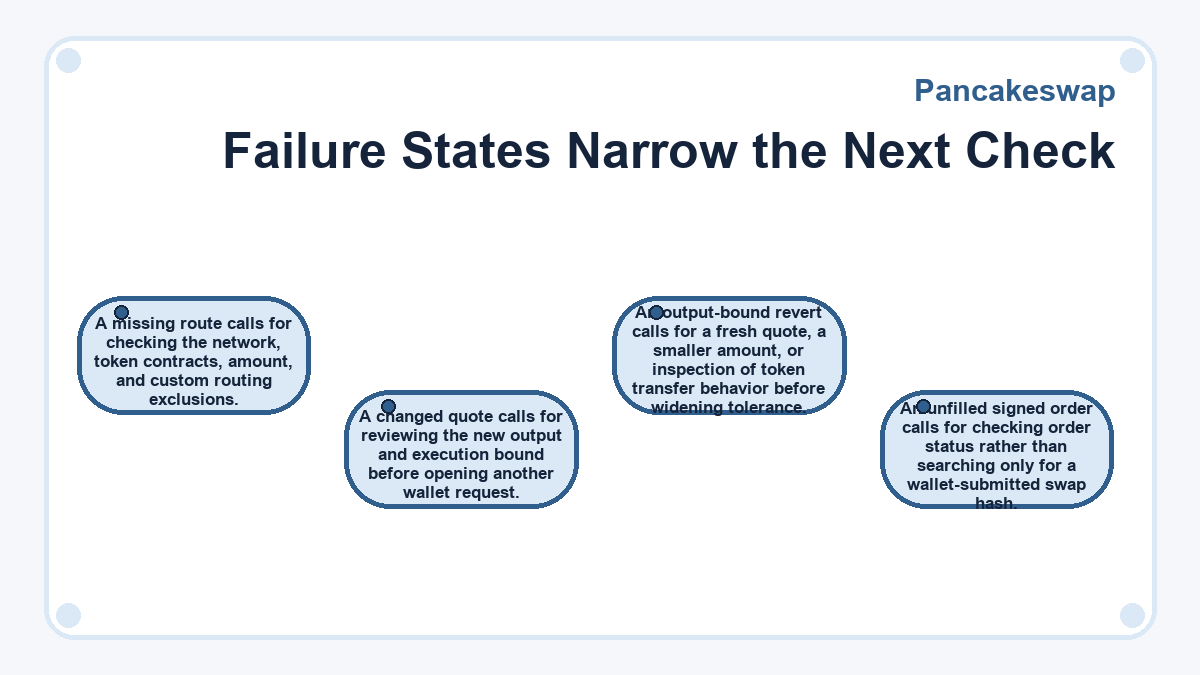
- A missing route calls for checking the network, token contracts, amount, and custom routing exclusions.
- A changed quote calls for reviewing the new output and execution bound before opening another wallet request.
- An output-bound revert calls for a fresh quote, a smaller amount, or inspection of token transfer behavior before widening tolerance.
- An unfilled signed order calls for checking order status rather than searching only for a wallet-submitted swap hash.
A reverted on-chain swap can still consume the network fee because the chain processed the failed transaction. Repeated reverts may also come from a fee-on-transfer token or transfer restrictions. A wider tolerance can accommodate a documented transfer fee by allowing a lower minimum output or a higher maximum input, depending on how the fee is applied. It cannot make a blocked transfer executable.
The Settled Record Replaces the Estimate
The settlement record answers whether the swap succeeded and what changed. For a wallet-submitted transaction, match the hash to the correct network and wallet, check its success or revert status, and compare token transfers with the wallet’s final balance. Interface history is convenient, but an indexing delay can make it appear later than the chain record.
Signed orders require two checks: the order must show a successful fill, and the received balance must reflect the output. A signature alone is not completion. In either path, compare the settled amount with the execution bound saved before submission rather than with an older quote. A successful transaction proves the recorded call executed; it does not establish that a token is authentic, unrestricted, or transferable in a later trade.
Questions and answers
-
Can I Enter the Desired Receive Amount Instead of the Spend Amount?
- Yes, the swap interface can estimate the required input from a chosen receive amount. This creates an exact-output trade, so the important protection is the maximum input the transaction may spend. Review that limit after every quote refresh. If pool conditions move beyond it before execution, the transaction should reject rather than take an unlimited input.
-
Does a Swap Quote Reserve the Displayed Liquidity?
- No, a displayed quote does not reserve pool liquidity or freeze its route. Other transactions can change pool balances, prices, and available paths before yours executes. The slippage setting defines the boundary for accepting that movement. Refreshing the quote creates new terms, so compare the new output, route, fee, and execution limit before signing.
-
When Should Custom Routing Be Reset to Its Default Settings?
- Reset custom routing when an otherwise supported swap shows no route or a materially worse quote after sources, multihop routing, or split routing were disabled. The reset restores the router’s candidate paths; it does not guarantee execution. Review the resulting route and output again because liquidity conditions may also have changed since the earlier quote.
-
Are Multihop Routing and Split Routing the Same Control?
- No, multihop and split routing change different parts of route construction. A multihop path passes through an intermediate asset before reaching the output token. A split route divides one trade across multiple paths. Either may improve an eligible quote, but enabling one does not enable the other, and their usefulness varies with the available liquidity.
-
Do fee-on-transfer Tokens Change the execution-bound Check?
- Yes, a token-level transfer fee can reduce the amount delivered or increase the amount needed, depending on how the contract applies it. That behavior may conflict with the transaction’s minimum-output or maximum-input condition. Raising slippage widens the acceptable range, but it cannot repair a token contract which blocks transfers or permits only selected addresses to sell.
-
Which Details Belong in a pre-sign Swap Record?
- Save the selected network, wallet address, input and output token contracts, amount, estimated output, route, displayed fee, price impact, and execution bound. These fields identify the exact proposal the wallet is being asked to authorize. After settlement, use them to distinguish a genuine execution difference from a comparison against another quote, route, or network.
-
Can Pancakeswap X Require a Native Network Token When the Order Itself Has No Gas Charge?
- Yes, a separate token approval may still require a network fee even when submitting the signed order does not. A previously sufficient allowance can remove that approval step, while an absent or inadequate allowance brings it back. Read each wallet prompt separately so an approval transaction is not mistaken for the order submission or its eventual fill.
-
What Should I Check When Interface History and the Wallet Balance Disagree?
- Match the wallet address, network, token contract, and transaction or order identifier before comparing amounts. Interface history may update after the underlying chain record. For a wallet-submitted swap, use the confirmed receipt and token transfers; for a signed order, confirm its fill status and the resulting balance. A pending or reverted record does not establish receipt of the quoted output.